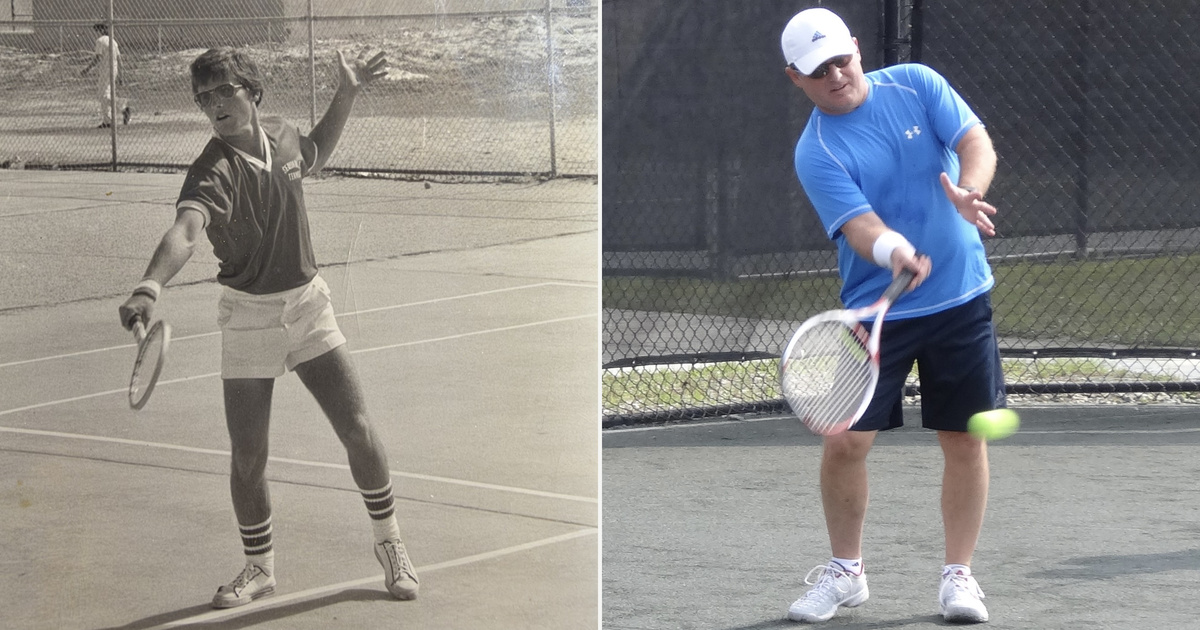
“How long have you been playing tennis?”
John asked me during a changeover. He had recently joined our regular doubles group. He is about my age and an exceptionally good player. He had told me that he’d been playing since he was a kid and had played in college. It was an ordinary question, the kind tennis players ask each other all the time.
“Since I was a kid,” I said.
Tennis had been part of my life for so long that I rarely thought about how it began. It was simply something I had always done, something I loved. But as we walked back onto the court, I thought about Neil.
One summer afternoon, when I was ten years old, a boy named Neil Scannell walked past my house in St. Petersburg, Florida. He lived in the neighborhood and was on his way home. He stopped at the end of my driveway.
“Do you know how to play four square?”
“No,” I said.
“I’ll teach you.”
He pulled a piece of chalk from his pocket and drew four squares on the driveway. He had a ball with him and began bouncing it across the lines, showing me how the game worked.
There was just one problem. Four square needed four players, and there were only two of us.
Neil had another idea.
“Then I’ll teach you how to play tennis.”
“Why?” I asked.
“Because it’s fun, and you can play it your entire life.”
We were boys. A lifetime was something neither of us could imagine.
Over the months and years that followed, we played tennis constantly. We played in the afternoons and into the night. As we grew older, there were times we played until three in the morning. Tennis was enormously popular then, and we grew up among some excellent young players.
Neil was a gifted athlete and a much better player than I was. He almost always beat me, but he made me feel that I belonged on the court with him.
I remember how he encouraged me. He would compliment my serve or my forehand, and he always had something good to say about my game. I knew how good Neil was, and that made his praise mean something. He had introduced me to tennis, but just as importantly, he gave me the confidence to keep playing.
My family eventually moved to nearby Seminole. Neil attended St. Petersburg High School, and I went to Seminole High. We played on our school tennis teams and sometimes found ourselves on opposite sides of the net. We remained friends, and when we went to the University of South Florida, we were roommates our freshman year.
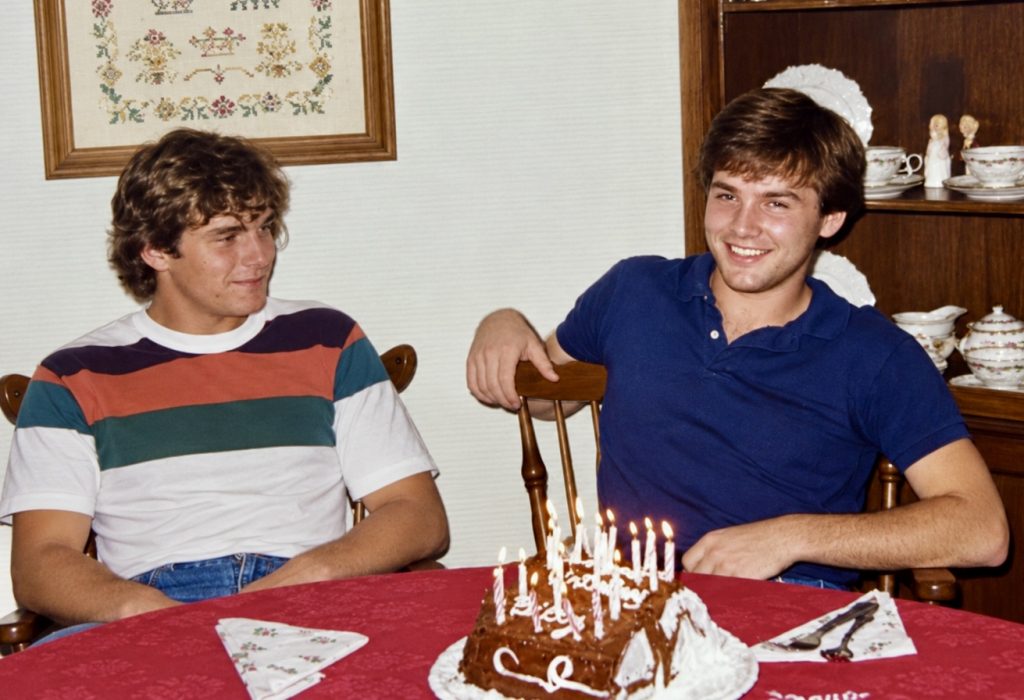
Neil continued to excel at tennis. He played for USF, and in 1980 he won a match that secured the team’s fourth consecutive Sun Belt Conference championship. He later told the student newspaper that he knew if he lost, the team lost. That was Neil. He was a fierce competitor, and he loved the game.
I loved the game, too. It was something I enjoyed, something I could always return to, no matter what else was happening in my life.
After college, our lives took different directions. I went to medical school and became a physician. Neil became an attorney. We gradually lost touch, as old friends sometimes do, without ever intending to.
But I never stopped playing tennis.
During the long years of medical training and the demands of practice, tennis gave me something to look forward to. It was a way to get away from work, enjoy some friendly competition, and spend time with people I liked. Many of my closest friendships developed on tennis courts. Some have lasted for decades.
Tennis also brought Susan into my life.
We met on the tennis courts in high school. Tennis was a big part of our courtship and remained part of our marriage. Susan played for many years, developing her own friendships through the game.
We have now been married for more than forty years. We raised two sons and have grandchildren.
I sometimes wonder how differently my life might have turned out had I never learned to play tennis. Would Susan and I have met? Would we have married? Would the life we built together ever have happened?
I cannot know. But when I trace my marriage and my children back far enough, I arrive at a driveway and a piece of chalk.
In 1991, I learned that Neil had died at his home in Wesley Chapel, Florida. He was thirty-three years old.
Although he had become an attorney, he had never left tennis. He was also teaching at the Harry Hopman Tennis Academy at Saddlebrook, one of the country’s premier tennis academies at the time. The boy who had taught me tennis was still sharing the game with others.
I was shocked by his death. I hadn’t seen or spoken with Neil in years, but I had always assumed he was out there somewhere, living his life as I was living mine.
I was a pallbearer at his funeral.
Neil was buried in St. Petersburg. His grave is marked by a small bronze plaque bearing his name and the dates of his birth and death.
I remember feeling terribly sad that his life had ended so young. We had been good friends growing up, and I wished we hadn’t lost touch. I knew, of course, that Neil had introduced me to tennis. But at the time, I hadn’t fully appreciated how much that gift had come to mean in my life.
The years passed. My children grew up, my career progressed, and eventually I retired. Through it all, I kept playing tennis.
It was John’s simple question during that changeover that made me think about Neil in a way I hadn’t before. I began remembering our childhood, the countless hours we spent playing, and the encouragement he gave me. I thought about the friendships tennis had brought into my life, the enjoyment it had given me, and, most of all, Susan and the family we had raised together.
I began to see more clearly just how much of my life had grown out of Neil’s friendship.
Not long ago, I came across a 2025 magazine profile of a tennis professional named Bill Aronson. The article identified Neil as one of the people who had mentored Aronson early in his career at the Hopman Academy.
I had never heard of Aronson before. Yet we had both been influenced by the same man, at different times and in different ways.
I wondered how many others Neil had encouraged or taught over the years. How many had gone on to share what they learned with someone else? His influence had reached people and places I knew nothing about.
For years, when I thought about Neil, I thought about how young he was when he died. Thirty-three years seemed terribly short, and it still does. Nothing I have come to understand makes his death any less tragic. I think about the years he never had and everything he might have done.
But I see something now that I didn’t see before.
The two dates on his plaque mark the years he lived. They do not mark how far his life has reached.
Neil could have kept walking that afternoon. Instead, he stopped to talk to me. He wanted to share something he loved. There was nothing extraordinary about what he did. He was simply being a friend.
Yet the goodness that came from that simple act grew into something neither of us could have imagined. What began as an afternoon of play became part of a lifetime.
Looking back, I see God’s grace working through the generosity of a boy who stopped on his way home.
And it has made me think differently about the people whose lives have crossed my own.
We all receive things from others that help shape who we become. Sometimes we remember those gifts and the people who gave them. But often their influence becomes so much a part of us that we no longer think about where it began.
And what about the things we give?
I spent decades practicing medicine and met thousands of patients. Some I knew for years, others only briefly. I sometimes wonder whether something I said or did meant more to someone than I ever realized.
We spend our lives receiving gifts whose origins we may not recognize and giving gifts whose consequences we may never see.
I think about that when I hear someone say that their life hasn’t amounted to much. I wonder how often we underestimate the meaning of our own lives simply because we cannot see all the ways we have touched others. The value of a life is not measured by what others can point to, and none of us can fully know the good we may have brought into the world.
That has deepened my understanding of God’s grace. We can freely offer something good to another person, but we cannot know what will become of it. The kindness itself may seem ordinary, even insignificant. Yet God can work through those choices in ways that extend far beyond anything we intended or imagined.
Jesus once told a parable about a man who scatters seed on the ground. The man sleeps and rises, night and day, and the seed sprouts and grows, though he does not know how.
I have read that parable many times. Now, when I read it, I think of Neil standing in my driveway with a piece of chalk in his hand.
Neil never knew what his gift would become. I hadn’t spent all these years remembering it. I had spent them living it.
All those years ago, Neil told me I could play tennis my entire life.
He was right. I wish I could have told him.
For more about Neil’s influence on others, see the April 2025 issue of Racquet Sports Industry, whose profile of tennis professional Bill Aronson on page 63 names Neil among his early mentors at the Harry Hopman Tennis Academy. The Parable of the Growing Seed (Mark 4:26–29) offers a biblical perspective on the mystery of how goodness grows beyond what we can see.